


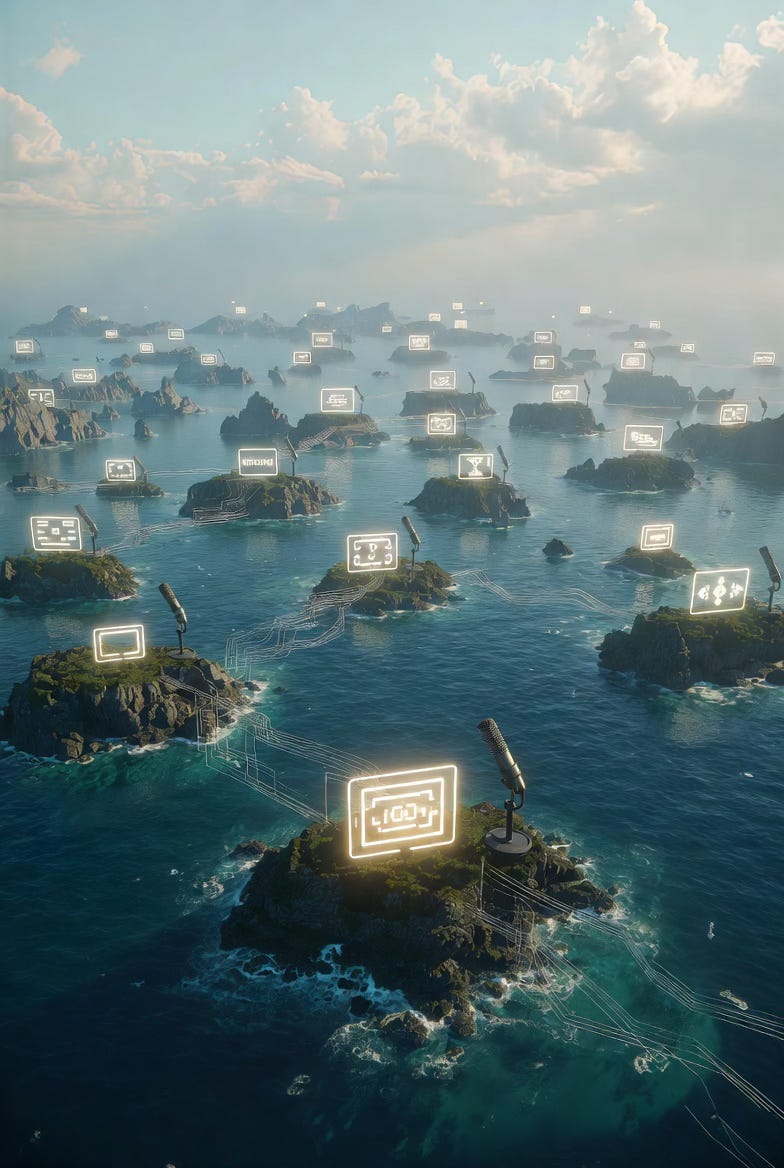
A few months ago I finally read Michael Rectenwald’s 2019 book Google Archipelago: The Digital Gulag and the Simulation of Freedom. At the time it struck me as sharp, maybe even a touch hyperbolic. Seven years on, it no longer feels like hyperbole—it feels like prophecy.
Rectenwald took Solzhenitsyn’s image of scattered Soviet prison camps and applied it to our glowing screens: a vast, privately owned archipelago of platforms where dissent isn’t met with tanks or midnight arrests, but with shadow-bans, demonetization, throttled reach, and sudden account evaporation. The guards wear hoodies, not uniforms. The punishment is invisibility, not hard labor. And the genius of the system is that most inmates still believe they’re free.
Look around in 2025 and tell me he was wrong.
Every room now contains at least one portal that decides what you’re allowed to see next. Posts vanish without explanation. Entire conversations are herded into approved corrals while others are left to wither. Your every click, pause, and scroll is harvested and stored forever in server farms that outnumber the stars you can see at night. The terms of service mutate overnight, and we shrug because opting out isn’t an option.
Search results are personalized—not to inform you better, but to keep you comfortable. Ads from a careless purchase five years ago still stalk you. A video surges, then playback is “restricted.” Accounts cultivated for a decade disappear after one anonymous report. Labels—“misleading,” “lacking context,” “hate speech”—are slapped on opinions the platform’s trust and safety teams find inconvenient. Refresh, and the discourse has already been sanitized.
Inside the glass campuses, employees parade in lockstep ideological colors. Leaked memos reveal which views are career-enhancing and which are career-ending. Antitrust hearings drag on like theater while market share creeps ever higher. Every photo, every voice memo, every late-night search lives forever in someone else’s vault. The microphone on your kitchen counter waits patiently for its next wake word.
One tap and you agree to whatever new rules they wrote while you slept.
One flag and a voice is erased.
One unannounced update and yesterday’s acceptable opinion becomes today’s violation.
And the most chilling effect of all? We police ourselves.
We learn the forbidden words, the risky questions, the topics that shrink our audience to nothing. We soften, hedge, self-censor—not because some censor is standing over us, but because we’ve watched what happens to those who don’t. Some of us retreat to smaller, safer islands. Others perform ever-louder versions of the approved script, chasing the algorithm’s fleeting favor. The boldest voices are either perfectly aligned or perfectly amplified by outrage cycles—rarely anything in between.
This even extends to music. I’ve experimented with uploading tracks to SoundCloud—songs that push back against what’s often called “gender ideology.” Nothing hateful, no calls to violence, just sharp criticism of the prevailing orthodoxy. Yet any attempt to monetize them gets shut down fast. The platform’s guidelines explicitly protect “gender identity” from content that “promotes or encourages hatred or discrimination,” and in practice, that line gets drawn the moment you challenge the ideology itself. Critique the ideas, and you’re out—no ad revenue, no fan support payouts. It’s a perfect illustration of the archipelago at work: you can upload, you can be heard by a tiny echo chamber, but step too far outside the approved narrative and the money dries up.
We still tell ourselves we’re speaking freely because the box is always there, cursor blinking, waiting. But who actually hears us, how long our words survive, whether they reach anyone beyond our bubble—that’s decided by systems we don’t own, don’t audit, and can’t appeal.
The interfaces are beautiful, seamless, addictive. The connection feels total. Yet we’ve willingly moved onto a chain of islands floating in a corporate ocean, free to decorate our little plots, free to shout into the wind, but never truly free to leave or to speak without consequence.
This isn’t paranoia. It’s pattern recognition.
The convenience is undeniable. The control is equally undeniable. And the slow, quiet training of our voices—the way we’ve all started speaking a little more carefully, a little more like everyone else—is the system working exactly as designed.
I’m still here, still posting, still reading your comments—same as you. But the unease is growing: these platforms were never built to protect unfiltered speech. They were built to maximize engagement, minimize liability, and keep the advertisers happy. Everything else, including the range of what we feel safe saying, is negotiable.
So tell me: Have you noticed yourself pulling punches lately? Choosing safer words? Avoiding certain topics because you know what the algorithm does to reach? Or am I the only one feeling the chill?
I’m getting rather introspect in my convalescence these days. Must be the Tamsulosin or the Pyridium.


